

Products
Three products from one waste tyre
Pyrolysis separates a tyre into oil, carbon and steel. Each is supplied to industrial buyers across Nepal. Specifications, applications and inquiry details for each product are below.
01 Liquid industrial fuel
Pyrolysis Oil
Tyre Pyrolysis Oil (TPO) · Eco Furnace Oil
A liquid industrial fuel recovered from waste tyres. Its specification is close to light diesel oil, and it burns directly in boilers and furnaces without pre-heating or blending.
What it is
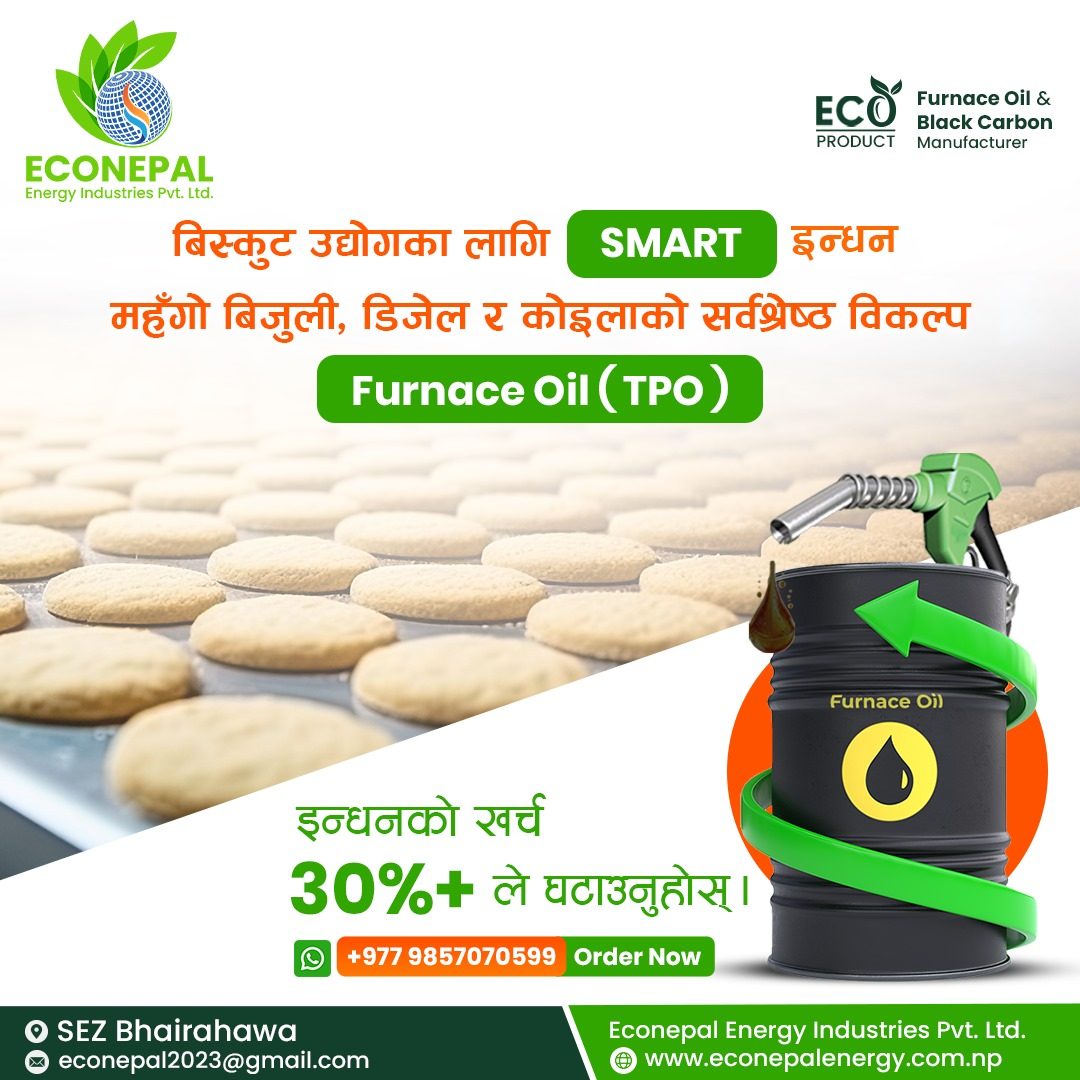
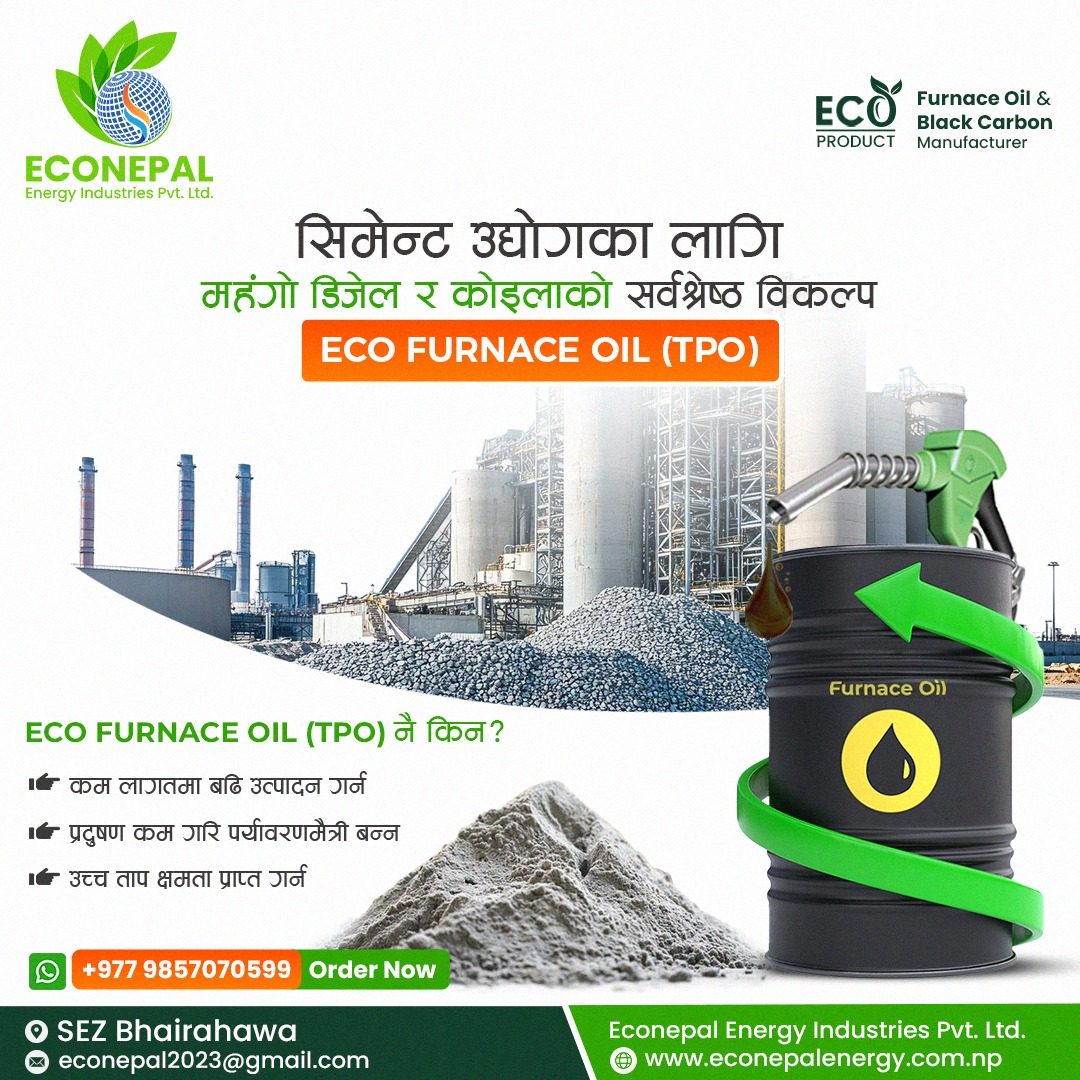
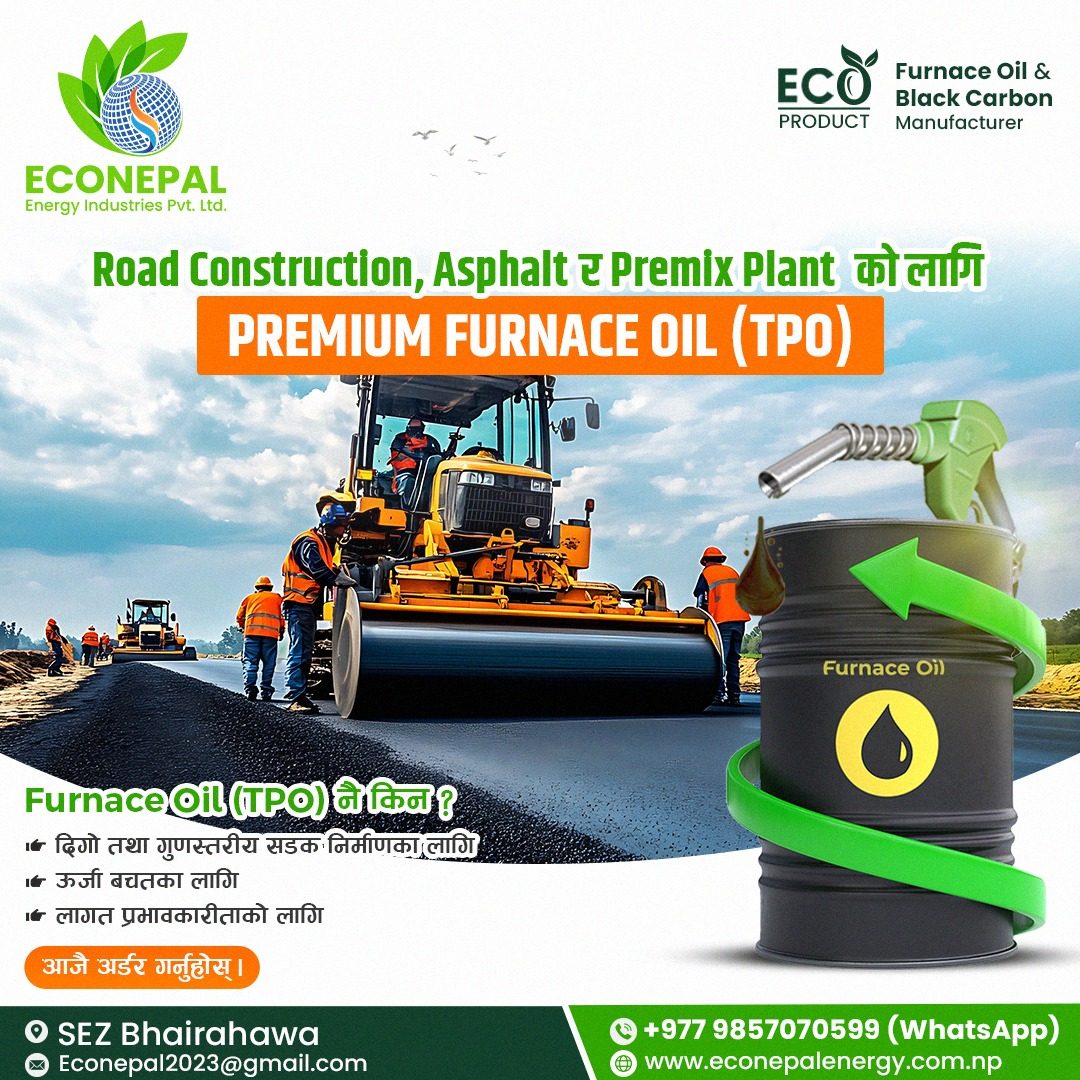
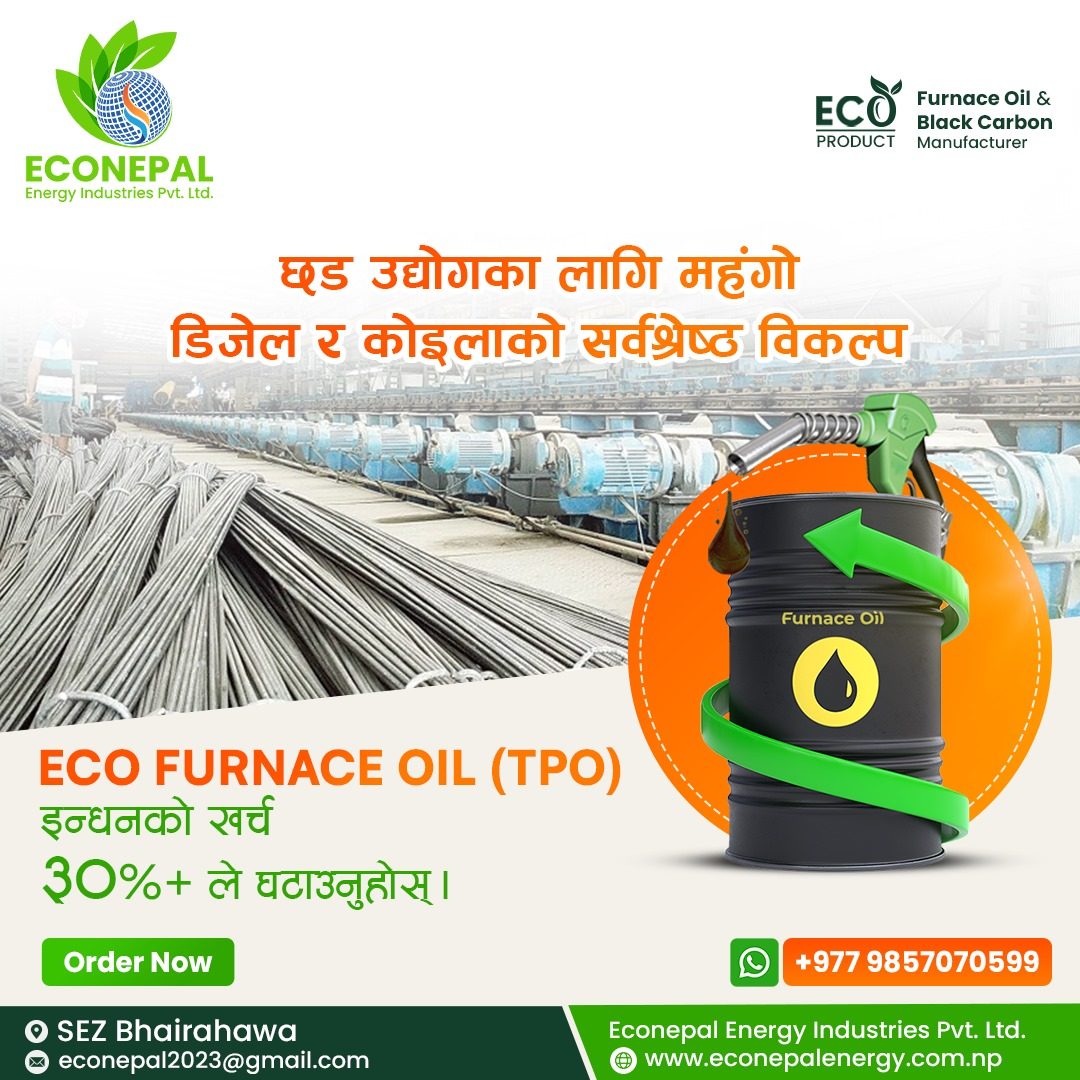
Tyre Pyrolysis Oil (TPO) is a dark liquid fuel for heavy industry, including construction, steel, cement and boiler plants, and for hotel heating. It compares with the furnace oil (FO) and light diesel oil (LDO) sold in the market, and generates heat by direct combustion in boilers and furnaces.
How it is produced
When shredded tyres are heated in the sealed reactor, the rubber breaks down into vapour. The vapour is cooled and condensed into oil.

10,400 cal/g ± 3%Calorific value, higher than furnace oil
Advantages over furnace oil
- No pre-heating needed. Low density and viscosity mean it can be used as it is, saving the energy furnace oil needs for heating before use.
- Higher calorific value than furnace oil: 10,400 cal/g ± 3%.
- Lower sulphur: up to 1% by weight, against up to 4% for furnace oil, so SOx emissions are lower.
- Lower ash and water content than furnace oil.
- No blending with furnace oil required. It burns directly, including in diesel burners.
- 5–10% saving against furnace oil, and up to 25–30% against light diesel oil.
Specification
| Test parameter | Method | Unit | Pyrolysis fuel oil | Furnace oil | Light diesel oil |
|---|---|---|---|---|---|
| Density at 15°C | ASTM D 1298 | g/cc | 0.87–0.93 | 0.88–0.98 | 0.85–0.87 |
| API gravity | ASTM D 1298 | – | 25.40 | 13.05 | 27.54 |
| Viscosity at 100°C | ASTM D 2161 | SUS | 29 | 65 | 42 |
| Sulphur, total | ASTM D 129 | % wt | Up to 1 | Up to 4 | Up to 1.8 |
| Water content | ASTM D 95-05 | % vol | Up to 0.25 | Up to 1.0 | Up to 0.25 |
| Ash | ASTM D 482 | % wt | Up to 0.05 | Up to 0.1 | Up to 0.02 |
| Calorific value | Bomb calorimeter | cal/g | 10,400 ± 3% | 10,000+ | 10,600 |
| Colour / appearance | ASTM D 1500 | – | Dark / black | – | – |
Typical values reported by Eco Nepal Energy Industries. Individual batches can vary. Ask us for the test report on a specific consignment.
02 Solid fuel and raw material
Carbon Char
Black Carbon Powder · sold under the Black Cat brand
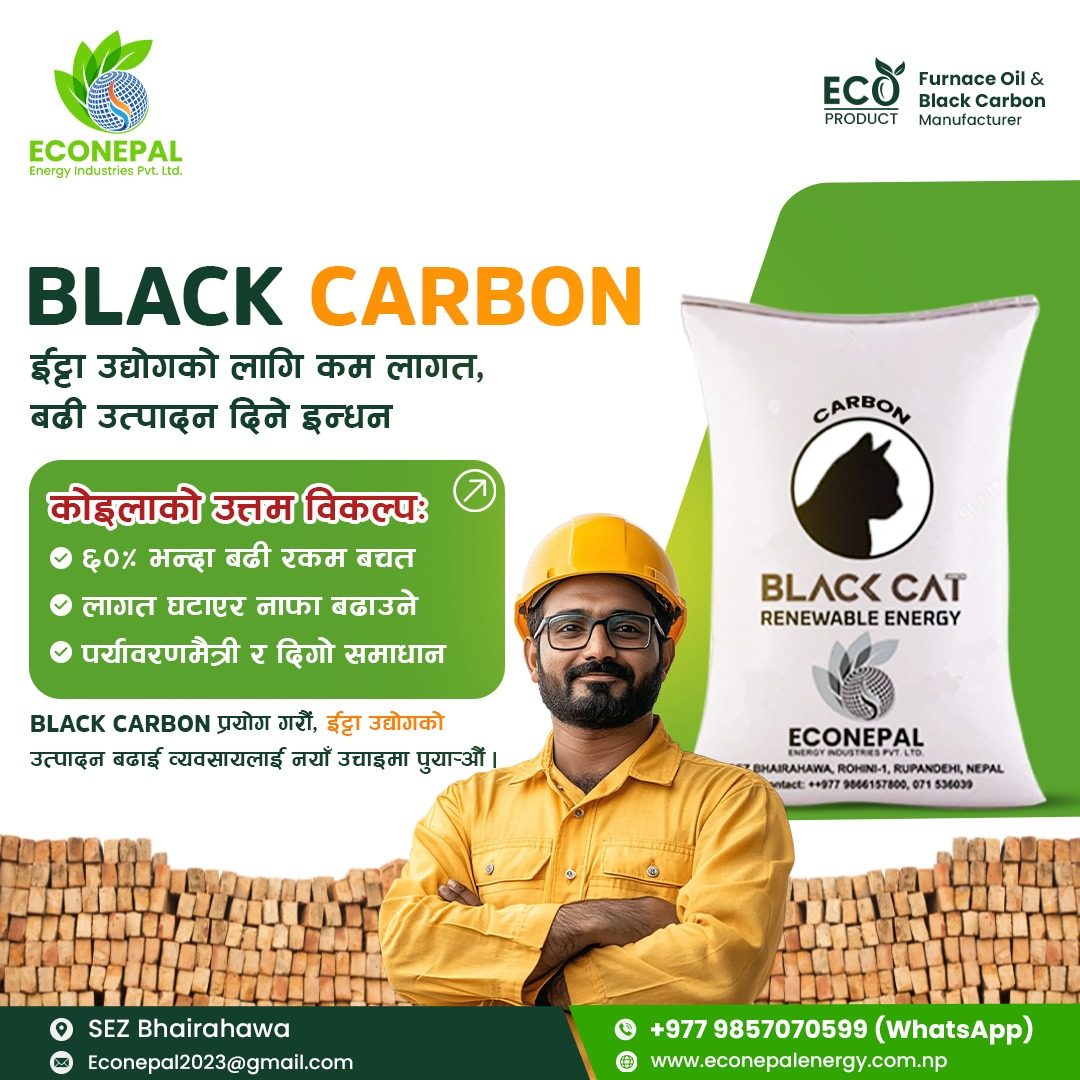
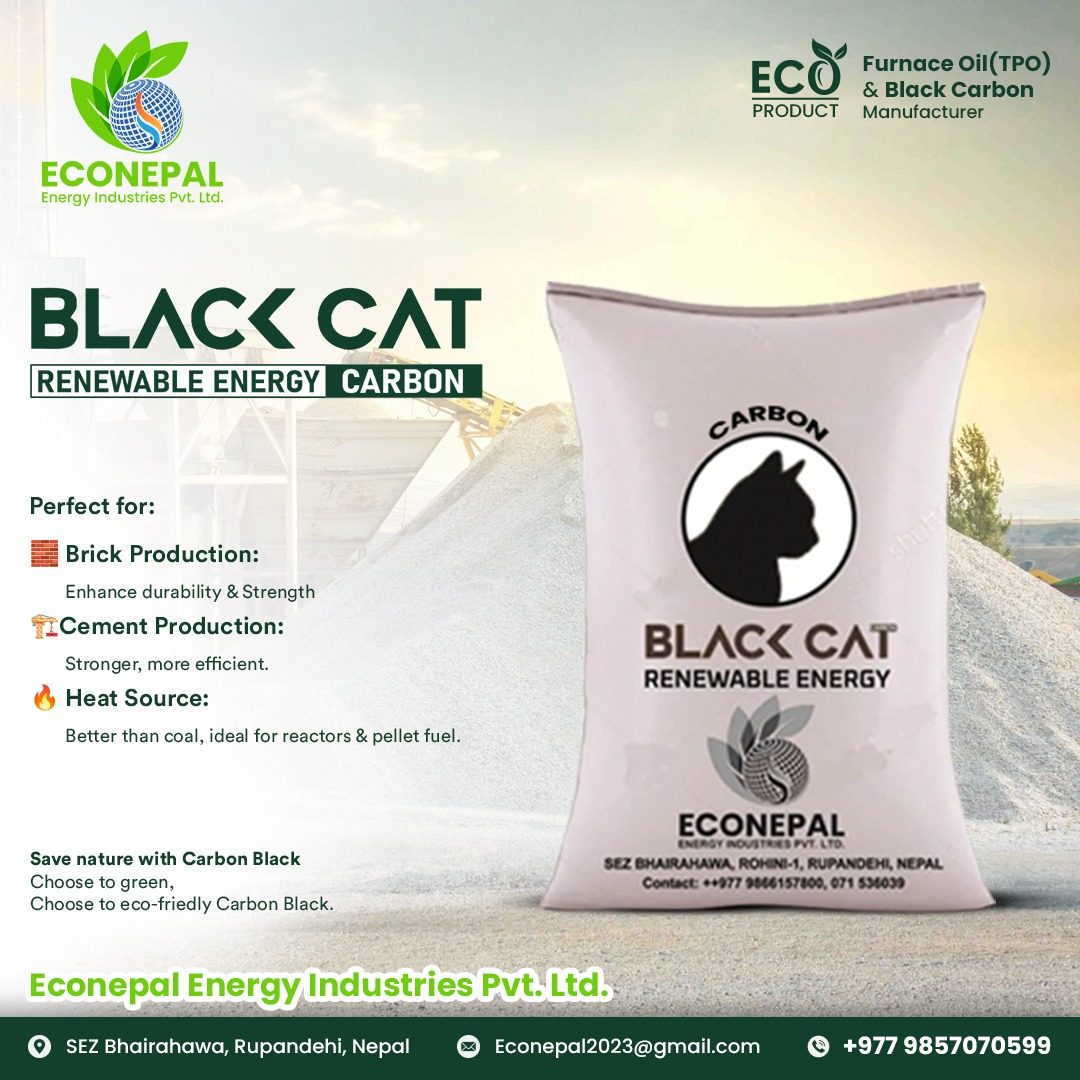
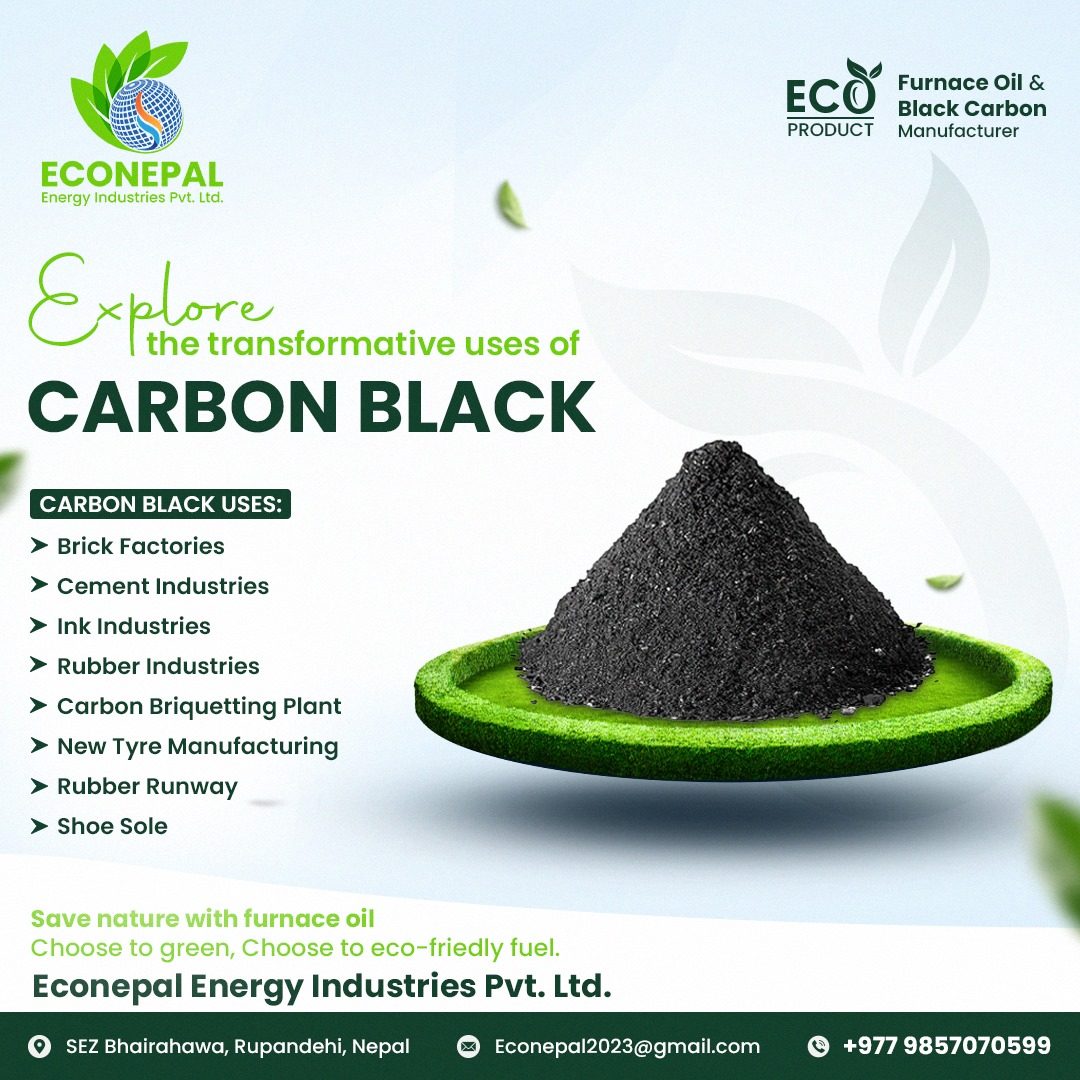
The carbon-rich powder left after pyrolysis. It is used as a coal substitute and heat source, and as a raw material in the rubber, ink and cement industries.
What it is
Carbon black is a raw material in many industries, where it adds strength, durability and colour. Our pyrolysis carbon powder is packed and sold under the Black Cat brand. It can be blended with cement as a partial replacement for coal and ash, used as a heat source with a slightly higher heating value than coal, and processed further into pellets as an alternative heating fuel.
How it is produced
The solid carbon that remains in the reactor after the oil vapour is drawn off is collected, cooled and packed as powder.

75–85% fixed carbonCalorific value 6,250 cal/g ± 2%
Benefits
- High calorific value, which the company rates as equivalent to ‘A’ grade coal imported from South Africa.
- Low moisture content, so less energy is wasted.
- Ash content comparable to coal.
- Low volatile matter, so less smoke.
- High fixed carbon, for more heat output.
Specification
| Test parameter | Unit | Carbon char |
|---|---|---|
| Calorific value | cal/g | 6,250 ± 2% |
| Moisture (max) | % | Up to 3 |
| Ash (max) | % | Up to 20 |
| Volatile matter (max) | % | Up to 3 |
| Fixed carbon | % | 75–85 |
| Particle size | mesh | Less than 30 |
| Colour / appearance | – | Black |
Typical values reported by Eco Nepal Energy Industries. Individual batches can vary. Ask us for the test report on a specific consignment.
03 Recovered metal
Steel Scrap
Recovered tyre steel wire · burned steel wire
Clean steel wire recovered from the tyre structure. It is baled to HMS 1 standard for compact furnace charging, with a melt yield of at least 84%.
What it is
Steel wire recovered from end-of-life tyres is sorted, uniform scrap. It looks like a bundle of long wires, with minimal ash and iron oxide. There is no rubber or fibre contamination, because the furnace reaches 450°C and fully pyrolyses them. When melted in a 5 kg arc furnace, our material has consistently yielded at least 84%.
How it is produced
The bead and belt wire that reinforce a tyre remain in the reactor after pyrolysis. They are separated from the carbon and baled for dispatch.

84% minimum melt yieldTested in a 5 kg arc furnace
Key characteristics
- Sorted, uniform scrap with minimal ash and iron oxide.
- No rubber or fibre contamination.
- Baled to HMS 1 standard under ISS codes 200 and 252.
- Bales prepared for compact loading and efficient furnace operation.
Specification
| Property | Specification |
|---|---|
| Scrap standard | HMS 1 under ISS codes 200 and 252 |
| Bale size | Not exceeding 30 × 24 inches |
| Bale weight | Not exceeding 60 kg |
| Bale density | Prepared for economical charging and efficient furnace operation |
| Melt yield | Minimum 84% (5 kg arc furnace) |
Typical values reported by Eco Nepal Energy Industries. Individual batches can vary. Ask us for the test report on a specific consignment.
Need a specification or a quotation?
Tell us the product, the monthly quantity and the delivery location. We will send current availability, test data and pricing.
Or call +977 71 536039
Email econepal2023@gmail.com